
AI search is changing how hospitality tech markets are understood.
Large language models now sit at the start of the buying journey, summarizing categories, comparing solutions, and explaining how different types of technology fit together. For many buyers, these AI-generated explanations form their first mental model of a market, long before they visit a vendor’s website or speak to sales.
This has consequences. When categories are clearly defined, LLMs can place brands accurately and explain their value in context. When categories are vague or inconsistently described, brands face two risks: being misrepresented or being excluded altogether. AI fills the gaps by averaging what it finds online, which can blur meaningful differences between products or leave certain providers out of the conversation entirely.
As a result, category clarity has become a strategic advantage.
In this article, we explore how AI-driven discovery reshapes market understanding in hospitality tech, why ambiguous categories lead to misrepresentation and exclusion in LLMs, and what brands can do to influence how their market (and their role within it) is explained.
Need help navigating AI-driven discovery? Abode specializes in hospitality tech and can advise on defining your category, shaping your brand story, and building credibility so AI understands your brand and your market. Talk to us today.
The new discovery landscape
At Skift’s Megatrends event in London, Jay Chauhan, Google’s industry head for travel, noted that travelers are increasingly using conversational AI to plan trips. But when it comes time to book, they still turn to traditional Google search and trusted websites.
The same pattern holds true in B2B.
A hotel or vacation rental manager researching a new hospitality tech platform may start in ChatGPT, Perplexity, or Gemini, asking broad, exploratory questions. But once they’re closer to a decision, they revert to Google Search to compare vendors, validate options, and move toward purchase.
In other words, search behavior is splitting.
Traditional search is becoming more transactional and navigational, capturing bottom-of-the-funnel intent. AI-driven search, meanwhile, is handling research, education, and early-stage discovery (the moment when buyers form their first impressions of categories, solutions, and market leaders).
The impact is already visible. Global Google search traffic dropped 33% between November 2024 and November 2025, largely due to AI Overviews and LLM usage.
For purchase-ready buyers, traditional search still provides the clearest path to conversion. But for discovery, education, and shortlisting, LLMs now sit firmly at the top of the funnel, shaping how buyers discover, contextualize, and evaluate products long before they ever visit a vendor’s website.
Organic search rankings still matter for long-term visibility and credibility, but LLM visibility has become just as critical in influencing early perceptions and decisions.
How LLMs define categories and market leaders
AI search behaves more like a market interpreter than a traditional search engine.
When buyers use LLMs for early-stage, in-depth research, they aren’t just looking for a list of vendors. Large language models summarize categories, compare providers, explain how markets work, and surface who matters and what to know.
In other words, instead of simply retrieving information, LLMs interpret it.
AI-generated responses are synthesized from trust signals across the web, not pulled from a single source. To decide which brands to include and how to describe them, LLMs prioritize companies with clear positioning, consistent narratives, credible third-party validation, and structured content they can easily summarize.
At a minimum, the model needs to recognize that your company is legitimate, understand what you do and who you do it for, and see repeated evidence that you operate with authority in a defined category.
This is where the meaning of brand has fundamentally shifted.
Brand is no longer just about awareness or recall. In an AI-driven discovery environment, it directly influences discoverability, trust, and ultimately conversion. Your brand becomes a breadcrumb trail across the internet that makes it easier for LLMs to find you, understand you, and recommend you as part of an answer.
In practice, LLMs rely on three primary trust signals:
- Earned media and third-party validation
- Thought leadership and demonstrated expertise
- Consistency and recency of messaging across sources
Using these signals, LLMs present a version of the market that feels coherent, structured, and authoritative.
That explanation isn’t guaranteed to be perfectly accurate, but it is treated as credible.
And that credibility shapes early assumptions about categories and leaders, often before buyers, journalists, or investors ever engage directly with a brand.
Whether those assumptions are fully correct or not, they still influence how markets behave.
Why category ambiguity kills AI’s understanding of your market
In AI search, unclear or overlapping categories prevent models – and thus potential buyers – from accurately understanding your market.
Buyers rarely begin their research with brand names. They start by trying to understand the category itself: what type of solution they need, who typically provides it, and which options are worth comparing. LLMs are designed to answer those questions by interpreting the market on the buyer’s behalf.
In complex sectors like hospitality tech, that interpretation is difficult. Categories are poorly standardized, described inconsistently, and often defined differently by founders, media, investors, and buyers. Being present in AI search does not mean being understood by it.
When clarity is missing, AI systems don’t attempt to resolve the ambiguity. Instead, they average it.
The outcome:
- Competitors are grouped together inaccurately
- Differentiation is flattened into generic language
- Legacy narratives persist long after strategies and products have evolved
- Certain providers get excluded from the conversation entirely
If a category lacks clarity, every brand operating within it loses.
Here’s a real example we’ve seen play out in hospitality tech. (Abode works with hospitality tech companies serving hotels and vacation rentals. We’re using an example from an adjacent vertical — restaurants — to illustrate how category ambiguity plays out in AI search.)
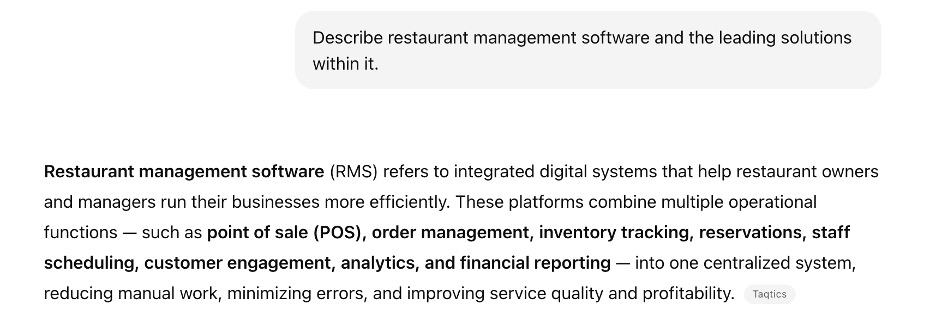
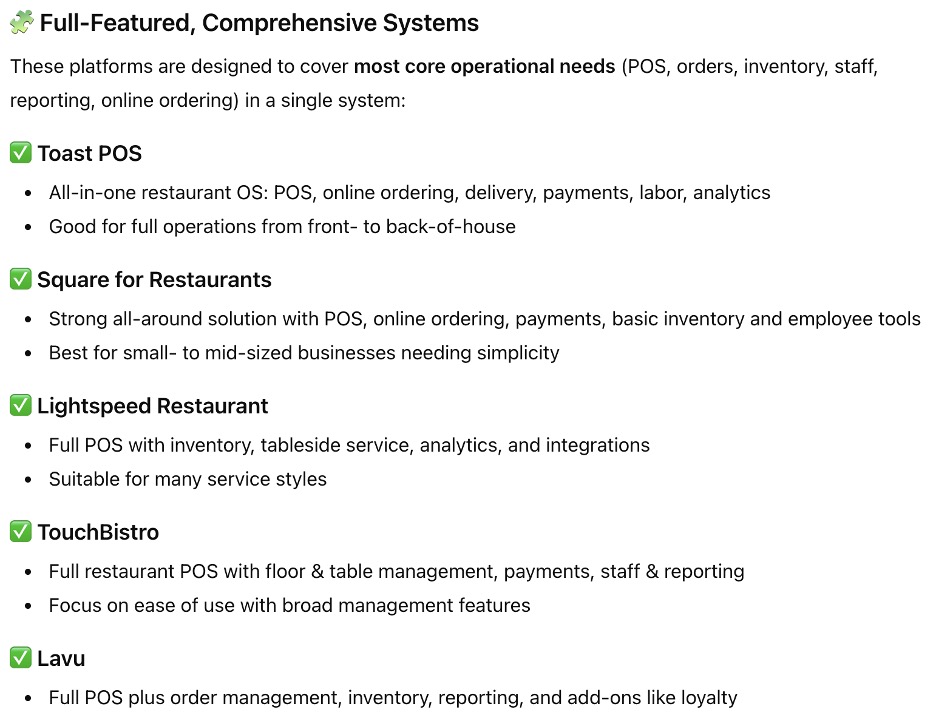
We asked ChatGPT a straightforward question: Who are the leading providers of restaurant management software? The initial response grouped a range of platforms together as if they were broadly comparable, implying they all offered comprehensive, all-in-one solutions.
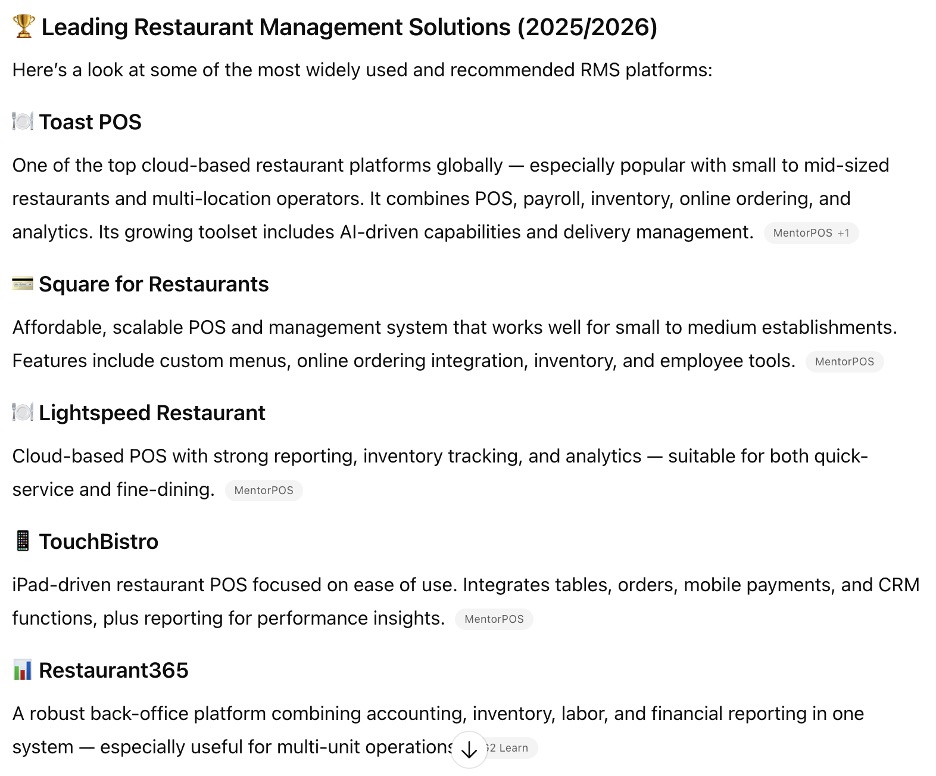
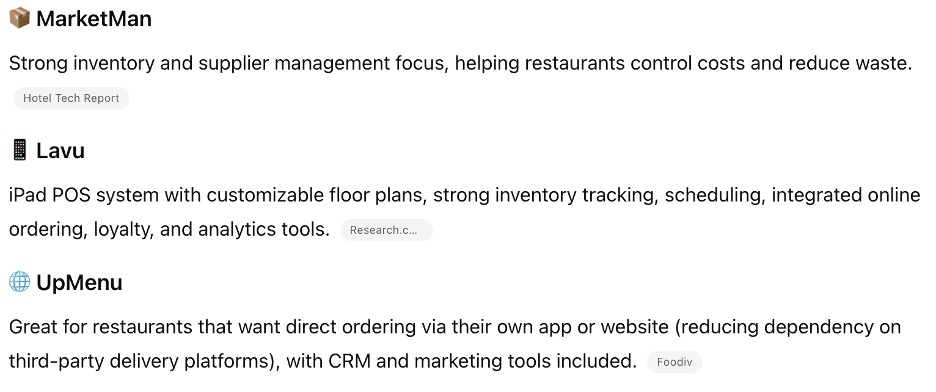
On the surface, it looked clean and confident. But once we started probing, the cracks showed.
With a few follow-up questions, it became clear that the platforms being lumped together actually serve very different purposes. Some are full-stack systems with a core POS. Others are specialist tools designed to plug into an existing POS, focused on functions like online ordering or operations rather than end-to-end management.
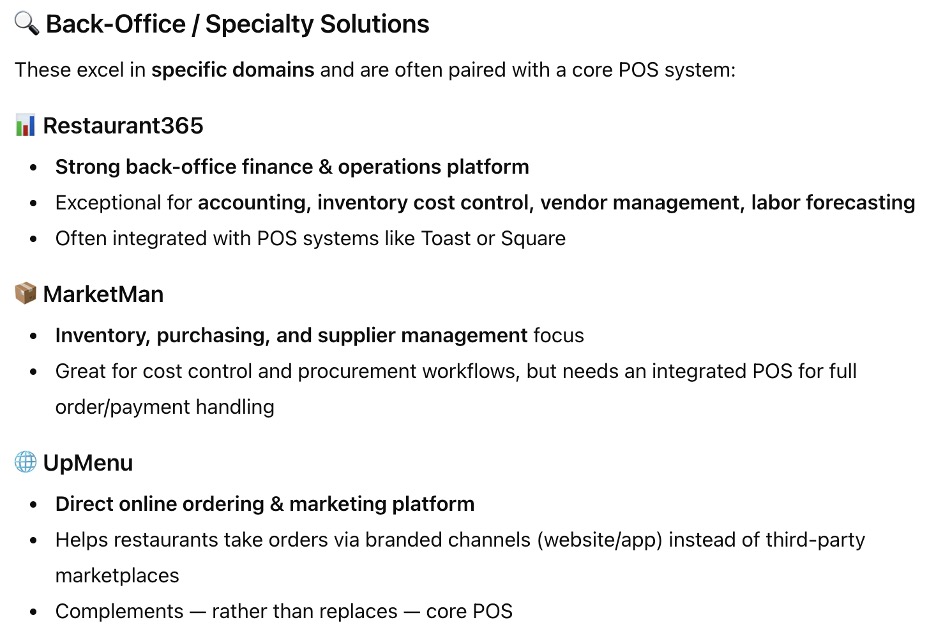
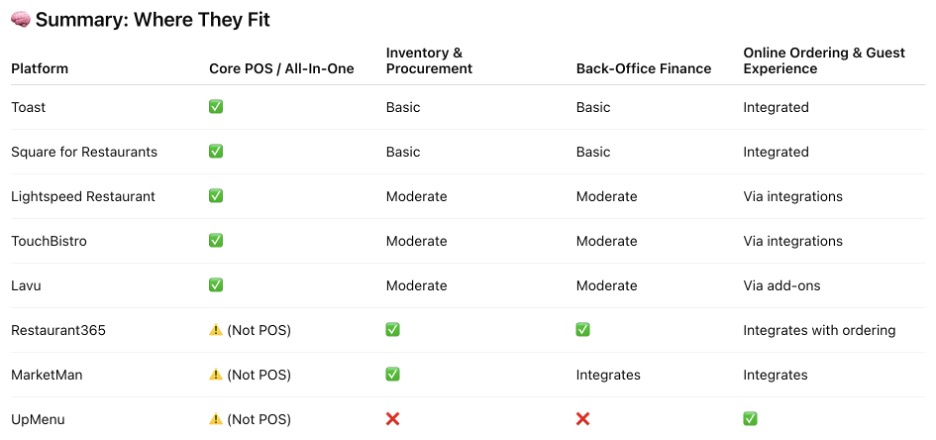
Even then, the picture wasn’t entirely right. In one case, ChatGPT claimed that UpMenu doesn’t have its own POS and described it as a specialist solution, when in fact, it does have its own POS and it is an all-in-one platform. The model wasn’t inventing this; it was reflecting how the product is commonly described online, even if that description is outdated or incomplete.
That’s the real issue. Restaurant management software is a vague, catch-all category. It’s used to describe everything from full platforms to highly specialized tools. When faced with that ambiguity, LLMs just smooth out the differences.
The result is a flattened version of the market, where meaningfully different products are treated as interchangeable and nuance disappears from early-stage discovery.
For software providers, this means that category definition can’t stop at a broad label. Brands need to actively reinforce what they are — whether that’s a POS platform, an inventory management system, an online ordering solution, or something else. Especially in crowded, adjacent categories.
Once LLMs start explaining a category in a particular way, that framing becomes self-reinforcing. It shows up again and again across AI tools, shaping buyer understanding long before anyone ever speaks to sales.
Correcting that narrative is possible. Establishing clarity before it hardens into AI-driven discovery is far easier.
How to create category clarity that AI can work with
The good news is that brands can work to define or even reshape how their category is represented in AI search. Doing so increases the likelihood of LLMs explaining your market accurately and describing your company favorably, and in the right context.
Start by asking yourself: “How is our category being explained — and does that explanation work in our favor?”
Here’s a step-by-step approach:
1. Observe how your category is currently described
Ask LLMs questions like:
- “Describe [category] and the leading solutions within it.”
- “List the top [category] providers and explain why each is considered a leader.”
- “Compare [competitor] with other providers in the [category], including strengths and weaknesses.”
Track whether your company appears, how it’s described, and which competitors are grouped alongside you.
2. Understand how your brand appears within that framing
Are you in the right product category? Do LLMs place you next to competitors that do similar work, or incorrectly equate you with companies in adjacent categories? Are all your offerings represented, or are key capabilities being mischaracterized or omitted?
Common hospitality tech category traps we regularly see LLMs struggle with include:
- PMS vs “all-in-one” platforms. Tools built to sit on top of a PMS are often grouped alongside core property management systems, even though they solve very different problems and are rarely substitutes.
- Guest messaging vs guest experience platforms. Messaging-first tools are frequently treated as equivalent to broader guest experience platforms that also include features like mobile check-in, upsells, and digital tipping, flattening both capability and value.
- Revenue management systems vs dynamic pricing tools. Full RMS platforms, pricing engines, and rate intelligence tools are often described interchangeably, despite major differences in automation, scope, and strategic impact.
- “AI in hospitality” as a category. Everything from chatbots to forecasting engines to back-office automation is routinely grouped under a single AI label, even when the underlying use cases, buyers, and outcomes have little in common.
In each case, LLMs reflect how categories are described across the web. When that language is vague or outdated, materially different products are treated as interchangeable, relevant providers get left out of the conversation, and important distinctions disappear early in the buying journey.
3. Identify gaps, outdated narratives, and risks
Where are misconceptions emerging? Are old messaging conventions persisting online? Are there categories where your differentiation is unclear or flattened? Map out the areas that need intervention to prevent AI from codifying inaccuracies.
4. Reinforce clarity through consistent, credible PR activity
LLMs learn from the broader content ecosystem. You can increase your chances of influencing their outputs by creating repeatable signals of authority and category expertise. Examples of practical PR activities include:
- Earned media coverage: Secure mentions in news outlets, trade media, and niche industry publications that explicitly position your company within the desired category.
- Thought leadership: Publish op-eds, bylined articles, or commentary that reinforce your category definition and expertise.
- Case studies and success stories: Showcase real-world examples of your product solving the problems your category addresses.
- Educational content: Create whitepapers, original research, and market reports based on proprietary data to define the category, highlight unique insights, and establish your brand as the go-to authority.
- Third-party validation: Encourage reviews on trusted platforms and ensure your Wikipedia or directory listings are accurate and category-specific.
- Consistent messaging across channels: From press releases to website copy to social posts, use the same language and framing to reinforce category clarity.
These activities do two things at once: they signal trust and authority to humans, and machine-readable signals that LLMs rely on when constructing explanations of a market.
The key is repetition and consistency. LLMs synthesize answers based on patterns across sources, so a coherent, repeated narrative across multiple authoritative channels increases the probability of your brand appearing correctly in AI-generated summaries.
When applied consistently, this approach improves the chance of AI search accurately reflecting your brand — establishing your category authority and shaping perceptions before a prospect even visits your website or engages with sales.
Shape how AI sees your market
In hospitality tech, unclear categories let AI flatten differences, misrepresent products, and distort buyer understanding. You can fix this by defining your category clearly, reinforcing expertise through PR and thought leadership, and ensuring accurate third-party validation.
At Abode, we live and breathe hospitality tech. Through strategic communications and PR, we help you tell your story, build trust and authority, and shape the narrative not just around your brand, but around your entire category. That way, you increase your chances of AI not only finding your brand but also understanding it.
Talk to us today.