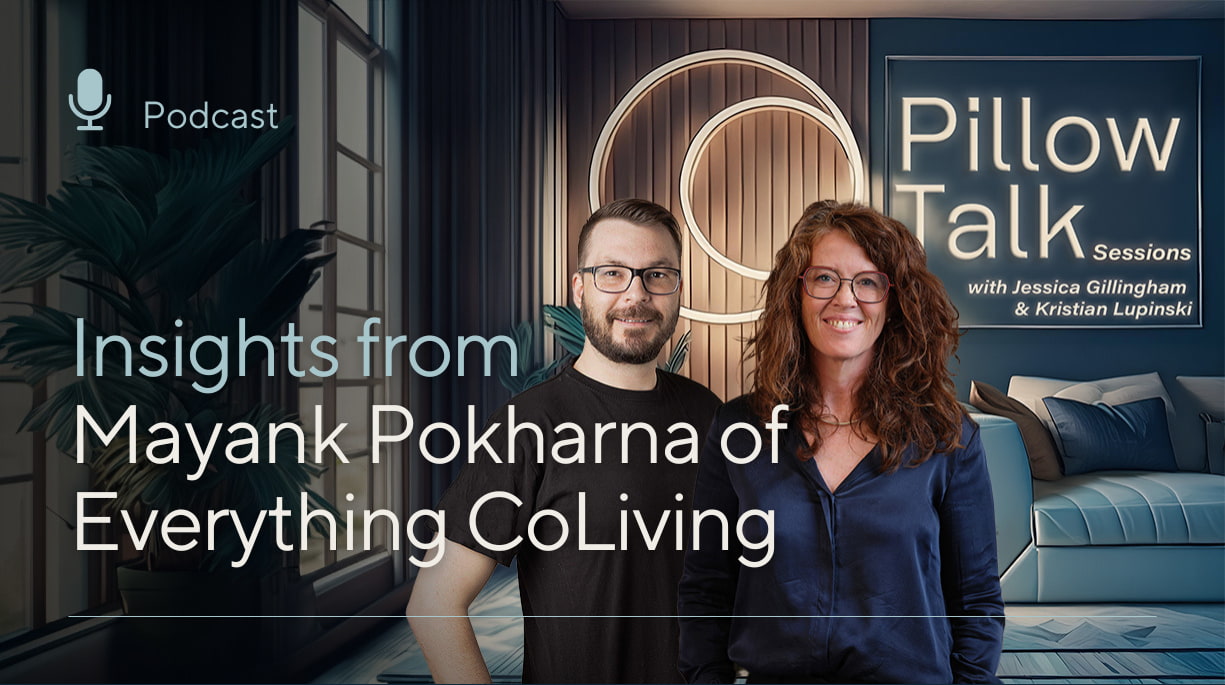
In this episode of Pillow Talk Sessions, Mayank Pokharna, CEO of Fllat.com and founder of Everything CoLiving, joins hosts Kristian Lupinski and Jessica Gillingham to share a decade’s worth of hard-earned insights from the front lines of co-living. From scaling operations in India to building tech platforms used across 17 countries, Mayank offers a global perspective on what it really takes to succeed in this fast-evolving space.
The conversation begins with Mayank’s journey, starting with his early venture Simply Guest in Bangalore. With 500 units across 17 locations, the startup taught him key lessons that now guide his approach: get the basics right before focusing on community, avoid overspending on early marketing, and know your unit economics inside out. For Mayank, operations always come first. “Tech is an enabler,” he says, “but this is still a people and space business.”
That belief led to the development of Jumbo Tiger, a property management platform designed specifically for co-living operators. After 20 months of development, it launched to over 100 users in 17 countries with strong early traction. The platform is part of a larger ecosystem powered by Everything CoLiving, which now supports operators with advisory, marketing, and training services. Mayank sees this dual model—tech plus lived operational experience—as the best way to drive meaningful impact.
The discussion also zooms out to explore the global state of co-living. Definitions vary widely by region. In India, affordability is the priority, with average monthly rents around $150. In Europe, the focus is on experiential and design-led living for digital nomads. In the US, co-living often blends affordability with a sense of curated community. There’s no one-size-fits-all model, and Mayank argues that success depends on understanding the cultural context. “If you want to grow globally, you have to act locally,” he says.
That insight was shaped by over 400 conversations Mayank conducted with operators, consultants, and service providers across the world. These conversations formed the basis of a manual that categorizes best practices by region, business type, and market segment. It’s this attention to nuance that drives the strategic thinking behind Everything CoLiving.
The episode also unpacks what larger brands get right. Companies like Habit are able to maintain a consistent core proposition while adjusting their operations to meet local needs in places like Berlin, Singapore, and Lisbon. Joint ventures and local partnerships are essential for making this kind of flexibility possible.
Mayank also reflects on OYO’s foray into co-living and its eventual return to core hospitality. He views OYO’s journey as a case study in operational discipline. “If you can make something work in India, you can make it work anywhere,” he explains. The key takeaway is that hospitality success is not about maximizing moments of delight—it’s about minimizing points of failure.
As remote work fuels longer travel and changing lifestyle preferences, co-living is becoming a go-to option for the 18–34 demographic. Mayank notes that hotels often fall short for longer stays due to cost, making co-living a natural alternative. Current occupancy rates back this up, with operators reporting averages of 91 percent. Despite housing shortages in the UK and US, the problem isn’t supply—it’s that the product doesn’t match demand. “We don’t need more single-family homes,” Mayank says. “We need more co-living.”
Community, he emphasizes, doesn’t have to be expensive. In fact, the best examples are often low-cost and highly strategic. Casa Mia Co Living in Singapore spends just 0.5 percent of revenue on community events but has increased average stays from nine to thirteen months through consistent, ritual-based programming. For Mayank, community isn’t a cost center—it’s a revenue driver.
The episode wraps with a look at the challenge of scaling without losing identity. Niche communities work well at 50 units but often fall apart beyond 300 unless restructured carefully. The transition, he says, needs to be strategic. “You can’t take a fitness-only brand and apply it to a 500-unit portfolio without some serious adjustments.”
From Bangalore to Berlin, Mayank Pokharna is helping operators build smarter, more sustainable co-living businesses—grounded in data, guided by cultural understanding, and always focused on the people at the heart of the experience.