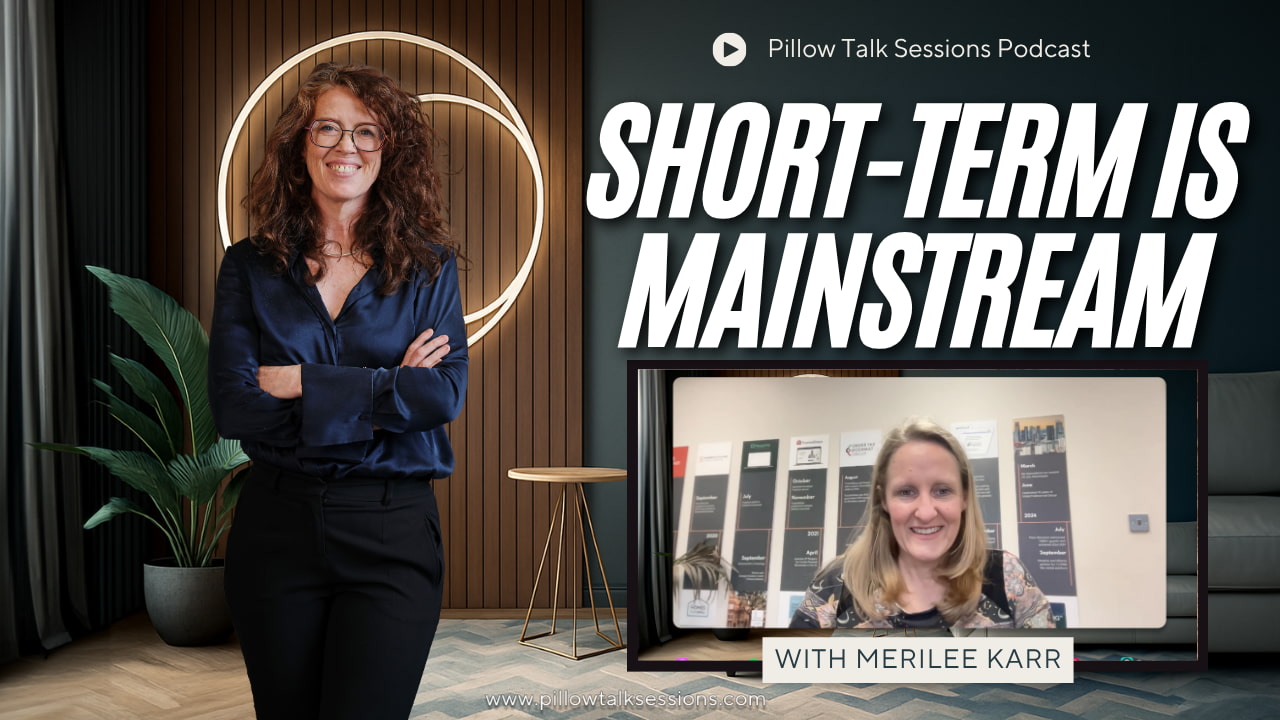
In this episode of Pillow Talk Sessions, Merilee Karr, CEO of UnderTheDoormat Group, joins host Jessica Gillingham to explore how short-term rentals are evolving into a more professional, institutional, and globally scalable sector and why technology, collaboration, and regulation will define its next phase.
UnderTheDoormat Group operates across multiple layers of the ecosystem, combining operations, technology, and distribution to support both individual property owners and institutional investors. Following its merger with Veeve, the business now manages luxury portfolios across London and Paris, delivering end-to-end services designed to maximise asset value and guest experience.
Merilee outlines how the group’s broader strategy is focused on growing the overall market, not just individual businesses. Through its technology platform, Hospiria, and distribution network, Trusted Stays, the company is helping bring more structure, access, and credibility to the short-term rental sector.
The conversation dives into:
- How Hospiria is enabling operators and real estate owners to manage flexible rental inventory at scale, from reservation systems to multi-channel optimisation.
- Why Trusted Stays, developed during the pandemic, has opened new distribution channels including government contracts and global GDS access.
- The rapid growth of the sector, now accounting for over 20% of accommodation nights in Europe, and the increasing need for professionalisation.
- The balance between consistency and authenticity, and why the sector must avoid becoming overly standardised through regulation.
- How institutional investors are adopting flexible rental models to optimise yields, manage voids, and respond to regulatory changes.
- The emergence of tenant subletting models as a controlled way to introduce flexibility while maintaining operational oversight.
Merilee also highlights the increasing convergence between hospitality and real estate. Branded residences, serviced apartments, and short-term rentals are becoming more interconnected, driven by consumer demand for flexibility and service. Technology is playing a central role in enabling this shift, particularly as traditional systems struggle to manage mixed-use and hybrid assets.
Hospiria has been designed to address that complexity. Its flexible, API-driven architecture allows operators to manage both individual units and large portfolios across different stay types, while integrating with hospitality systems to create a more unified operating model.
Regulation remains a key theme. Merilee advocates for balanced, proportionate frameworks that support growth while addressing housing concerns. Overly restrictive policies risk reducing supply and limiting the diversity of accommodation options, while thoughtful regulation can help raise standards and build trust across the sector.
Beyond Europe, the conversation explores emerging opportunities in the Middle East. With short-term rentals still representing a small share of the market, countries like Saudi Arabia and Oman are investing heavily in tourism infrastructure, creating significant growth potential for flexible rental models supported by technology and local partnerships.
At the same time, the industry is maturing. What was once considered an alternative asset class is becoming increasingly mainstream, with higher expectations around service, consistency, and compliance. Operators are being required to meet the standards of both hospitality and real estate, while maintaining the flexibility that defines the sector.
Looking ahead, technology, particularly AI, is expected to further transform operations, from pricing and distribution to guest communication and asset management. Platforms that can handle complexity, integrate across systems, and support multiple use cases will be central to that evolution.