
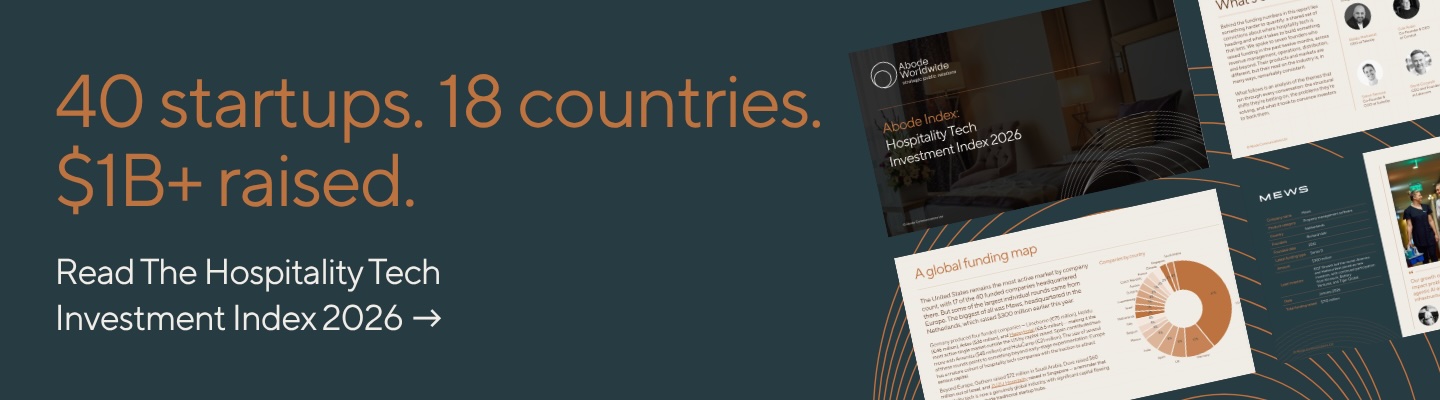
Hospitality technology had a significant year for investment. Over the twelve months from April 2025 to March 2026, 40 companies raised a combined $1 billion: a figure that reflects growing conviction among investors that the platforms being built today will define how hospitality businesses operate for years to come.
Today, we’re publishing the Abode Worldwide Hospitality Tech Investment Index 2026, our annual deep-dive into the funding, companies, and trends shaping the industry.
You can download the full report here (free, no form):
Below, we break down the key findings.
The $1 billion year: what the data shows
The headline number matters, but the pattern behind it matters more.
The three largest raises — Mews ($300 million), Kindred ($125 million across two simultaneous rounds), and Limehome (€75 million) — were all announced within a 90-day window between December 2025 and February 2026. A property management system, a home-swapping platform, and a tech-enabled apartment operator arriving at the same fundraising moment points to something broader than category-specific confidence. Investors are backing hospitality tech as a whole.
According to Canary Technologies’ 2026 study Navigating AI: Hospitality Shifts From Exploration to Execution, 71% of hospitality professionals say AI is having a significant or transformative impact on their industry, and 85% expect to allocate at least 5% of their IT budget to AI tools this year. Investors are reading the same signals.
The categories attracting the most capital
Property management systems
PMS companies raised more than any other category: seven companies, a combined $408.1 million, from Mews at $300 million to Amenitiz ($45 million), Arbio ($36 million), and Boom ($12.7 million).
Whoever owns the PMS layer of the stack has influence over everything else: teams, revenue, data, and guest journeys all flow through it. As operators consolidate their tooling, that central position becomes more valuable, not less.
The bigger shift is what well-funded PMS companies are doing with that position. Rather than relying on third-party integrations, they’re building new capabilities in-house and acquiring specialist platforms. Mews’ acquisitions of Flexkeeping (housekeeping automation) and DataChat (agentic AI) in late 2025 are a clear example. The direction of travel is toward becoming the single system a property needs to run.
“Instead of relying on a ‘Frankenstack’ of disconnected tools that need constant manual input, properties are moving toward AI agents that can proactively coordinate revenue, operations, and guest service in real time.”
— Richard Valtr, Founder at Mews
Vacation rental marketplaces
Six niche vacation rental marketplaces raised funding, each serving a clearly defined audience: Lake.com for lakeside stays, Wander for luxury homes, Gathern for Saudi Arabia, ELIVAAS and StayVista for India, and Holidu targeting price-conscious travelers through metasearch.
The investor case reflects a broader trend: travelers increasingly want experiences that match their specific interests and travel styles. Niche platforms deliver that in a way generalist OTAs can’t, attracting guests who are already aligned with a particular type of property, which means better conversion and better fit for operators.
Guest experience platforms
Four AI-powered guest experience platforms raised a combined $152.6 million: Duve, Chatlyn, Conduit, and Canary Technologies (the largest at $80 million, which also acquired mobile key platform OpenKey in February 2026).
What connects all four is the problem they’re solving: hospitality teams are expected to deliver responsive, personalized service with fewer staff than ever before. AI is handling the gap: automating guest messaging, digital check-in, upsells, and feedback, and freeing up staff time for the interactions that actually need a human.
“The skepticism around AI has really faded, and it’s becoming insanely transformative for the operators who are adopting it. The gap between early adopters and those waiting on the sidelines is widening fast.”
— Cole Rubin, Co-Founder and CEO at Conduit
Tech-enabled operators — Limehome, Kasa, and HolaCamp — raised a combined $151.9 million across three companies, just behind guest experience platforms and worth watching as a category in its own right.
The shape of the market
Who is raising, and at what stage
Of the 40 companies that raised in the past twelve months, 19 rounds were at pre-seed, seed, or Series A stage, against just four at Series C or D. Capital is flowing into a market still being built, with leadership positions still up for grabs.
The age profile is equally telling. Just over half of funded companies were founded after 2020, and 2023 alone accounts for ten of them — the largest founding cohort by a significant margin. That’s almost certainly no coincidence: 2023 was the year AI moved into mainstream commercial use, and many of those companies are building on foundations that simply didn’t exist before.
That said, fifteen of the 40 were founded between 2014 and 2019, with years of product development and customer traction behind them. Several of the largest raises came from this cohort, a reminder that the market has layers: AI-native challengers on one side, battle-tested scale-ups on the other.
A global funding map
The US remains the most active market by company count, with 17 of the 40 companies headquartered there. But some of the largest individual rounds came from Europe. The biggest of all was Mews, headquartered in the Netherlands.
Germany produced four funded companies: Limehome (€75 million), Holidu (€46 million), Arbio ($36 million), and Happyhotel (€6.5 million). Spain contributed Amenitiz ($45 million) and HolaCamp (€21 million). The size of several of these rounds points beyond early-stage experimentation: Europe has a mature cohort of hospitality tech companies with the traction to attract serious capital.
Further afield, Gathern raised $72 million in Saudi Arabia, Duve raised $60 million out of Israel, and ZUZU Hospitality raised in Singapore, demonstrating that hospitality tech is now a genuinely global industry.

What founders told us
The Index features perspectives from eight founders who raised capital in the past twelve months. Across every conversation, a few themes kept surfacing.
The biggest shift is that AI is no longer theoretical. It’s operational.”
— Bobby Marhamat, CEO at TakeUp
“Investors recognized that the legacy model of stitching together fragmented SaaS tools creates operational complexity and limits scalability. Boom brings everything into a single unified platform, and on top of that introduces AI agents that can understand, decide, and execute work.”
— Shahar Goldboim, Co-Founder and CEO at Boom
“With AI, you need to go beyond providing a simple product because the ceiling to build software has become much lower. Instead, you want to tell people how they can improve their business by using your product. There’s an education piece here that’s really interesting.”
— Simon Seroussi, Co-Founder and COO at SuiteOp
“Discovery and booking are starting to move beyond traditional websites and OTAs into AI-driven interfaces like ChatGPT. As traveler behavior evolves, distribution will increasingly happen through conversational and agent-based environments rather than search-and-click funnels.”
— Boris Pavlov, Co-Founder and CEO at OnSeason
What investors are backing
Platform businesses are getting the most attention, and for a specific reason. Unified systems generate more data over time, which improves their AI, which raises switching costs, which makes the platform harder to displace. Investors are backing that compounding dynamic; not just the product as it exists today, but what it becomes as it scales.
The pattern across the top raises is consistent. Investors are backing technology that operators rely on, not tools they experiment with and abandon.
The complete investment data: all 40 companies
The table below covers every company featured in the Index, with funding type, amount, lead investors, and date.
| Company | Category | Country | Founded | Funding Type | Amount | Lead Investors | Date |
| Breezeway | Operations platform | US | 2015 | Private equity | N/A | Resurgens Technology Partners | Mar 2026 |
| Wheel the World | Accessible travel platform | US | 2017 | Series A | $11M | Enable Ventures, Kayyak Ventures | Feb 2026 |
| RobosizeME | Workflow automation platform | Czech Republic | 2022 | Seed | $2M | SeedTwo Capital | Feb 2026 |
| Otamiser | Ranking management platform | Belgium | 2021 | Seed | $2M | Pitchdrive | Feb 2026 |
| Happyhotel | Revenue management software | Germany | 2019 | Series A | €6.5M | Reimann Investors | Feb 2026 |
| Daypass.com | Online travel agency | Mexico | 2023 | Seed | $2M | N/A | Feb 2026 |
| Kindred | Home swapping platform | US | 2021 | Series C | $85M | Index Ventures | Feb 2026 |
| Mews | Property management software | Netherlands | 2012 | Series D | $300M | EQT Growth | Jan 2026 |
| Limehome | Tech-enabled operator | Germany | 2018 | Venture round | €75M | Cheyne Capital | Dec 2025 |
| Duve | Guest experience platform | Israel | 2016 | Series B | $60M | Susquehanna Growth Equity | Dec 2025 |
| MAIC | Operations platform | Luxembourg | 2023 | Seed | €1M | Expon Capital | Nov 2025 |
| Amenitiz | Property management software | Spain | 2018 | Series B | $45M | Chalfen Ventures, Eight Roads, K Fund | Nov 2025 |
| HotelPORT | Content verification platform | US | 2019 | Debt financing | $1.5M | Hum Capital | Oct 2025 |
| Boom | Property management software | US | 2023 | Series A | $12.7M | Avenue Growth Partners | Oct 2025 |
| OnSeason | Direct booking tool | Bulgaria | 2023 | Pre-seed | €700K | Eleven Ventures | Oct 2025 |
| Hospitable | Property management software | US | 2016 | Community-led round | $1.5M | N/A | Sep 2025 |
| Lake.com | Vacation rental marketplace | Canada | 2023 | Pre-seed | $2.6M | BDC | Sep 2025 |
| Alltheway | Baggage logistics system | France | 2022 | Seed | €3.5M | Undisclosed | Sep 2025 |
| UnderTheDoormat Group | Property management system | UK | 2014 | Venture round | $7M | Omran Group | Sep 2025 |
| ZUZU Hospitality | Property management software | Singapore | 2016 | Series B | $5.9M | Undisclosed | Aug 2025 |
| Gathern | Vacation rental platform | Saudi Arabia | 2017 | Series B | $72M | Sanabil | Aug 2025 |
| Kasa | Tech-enabled operator | US | 2016 | Venture round | $40M | SLW | Aug 2025 |
| ELIVAAS | Luxury vacation rental platform | India | 2022 | Series B | $10.4M | Vertex Ventures SEA & India | Aug 2025 |
| Journey | Loyalty platform | US | 2024 | Seed | $7.7M | Lerer Hippeau, Slow Ventures | Aug 2025 |
| TakeUp | Revenue management software | US | 2021 | Series A | $11M | 1848 Ventures | Jul 2025 |
| Folio | Financial operations platform | US | 2023 | Series A | $14M | Construct Capital, Thrive Capital | Jul 2025 |
| StayVista | Luxury vacation rental platform | India | 2015 | Series B | $4.6M | JSW Ventures | Jun 2025 |
| Chatlyn | AI guest communication platform | Austria | 2022 | Series A | €8M | Smedvig Ventures | Jun 2025 |
| Canary Technologies | Guest experience platform | US | 2017 | Series D | $80M | Brighton Park Capital | Jun 2025 |
| Holidu | Vacation rental management platform | Germany | 2014 | Venture round | €46M | Key 1 Capital | Jun 2025 |
| HolaCamp | Tech-enabled operator | Spain | 2023 | Debt financing | €21M | Banco Santander Smart Fund | Jun 2025 |
| Arbio | Property management software | Germany | 2022 | Series A | $36M | Eurazeo | Jun 2025 |
| Wander | Luxury vacation rental platform | US | 2021 | Series B | $50M | Alumni Ventures, Fifth Wall, QED | May 2025 |
| S4labour | Workforce management platform | UK | 2010 | Private equity | £4.7M | YFM Equity Partners | May 2025 |
| Hotiday | Decentralized hotel platform | Italy | 2022 | Seed | €5.5M | P101 | May 2025 |
| Steadily | Property and liability insurance | US | 2020 | Series C | $30M | Two Sigma Ventures | Apr 2025 |
| ROH | Payments management platform | US | 2023 | Venture round | $9.2M | Highgate Ventures | Apr 2025 |
| Conduit | Conversational AI agent platform | US | 2023 | Seed | $3.1M | Pi Labs, Y Combinator | Apr 2025 |
| DIAMO | Revenue management software | US | 2024 | Seed | $4M | Thayer Ventures, Inovia Capital | Apr 2025 |
| SuiteOp | Guest operations platform | US | 2023 | Seed | $3M | ScOp Venture Capital | Apr 2025 |
Read the full report
The Hospitality Tech Investment Index 2026 includes the full funding trends analysis, founder perspectives from eight operators who raised in the past year, and detailed profiles of all 40 companies.
Download the full report here — free, no form required:

Frequently asked questions
How much did hospitality tech companies raise in 2025–2026?
In the twelve months from April 2025 to March 2026, 40 hospitality technology companies raised a combined $1 billion. The three largest rounds came from Mews ($300 million), Kindred ($85 million), and Limehome (€75 million).
Which hospitality tech category attracted the most investment?
Property management systems raised the most, with seven companies securing a combined $408.1 million. PMS platforms attract disproportionate investment because they sit at the operational core of hospitality businesses and have influence over every other layer of the tech stack.
Is AI driving investment in hospitality technology?
Yes, significantly. Most of the largest rounds went to companies building AI-native platforms. According to a 2026 study by Canary Technologies, 71% of hospitality professionals say AI is already having a significant or transformative impact on their industry.
Which countries are leading hospitality tech investment?
The US has the most funded companies, with 17 of the 40 headquartered there. But some of the largest individual rounds came from Europe — particularly Germany, which produced Limehome, Holidu, Arbio, and Happyhotel — and from Israel, Saudi Arabia, and Singapore.
What are investors looking for in hospitality tech right now?
Platform businesses with demonstrated product-market fit. Investors are backing unified systems that generate data, improve over time, and become harder to replace the longer they’re in use — not standalone tools that solve a single problem.
The Hospitality Tech Investment Index 2026 is published by Abode Worldwide, a strategic PR and communications agency specializing in hospitality technology and proptech.